Free Shipping:Orders $99 and Up
A Knife Fit For James Bond
The Gentleman’s Knife with a Mind-Boggling Twist
By Kevin Wells
A Jaw-Dropper
Some things in life just stop you in your tracks. You blink, transfixed, and ask yourself: “What the heck did I just see?!”
Anyone who has witnessed CRKT®’s mind-bending Fulcrum™ mechanism knows exactly that feeling. It moves in such an unexpected, puzzling way. Knives just don’t do that.
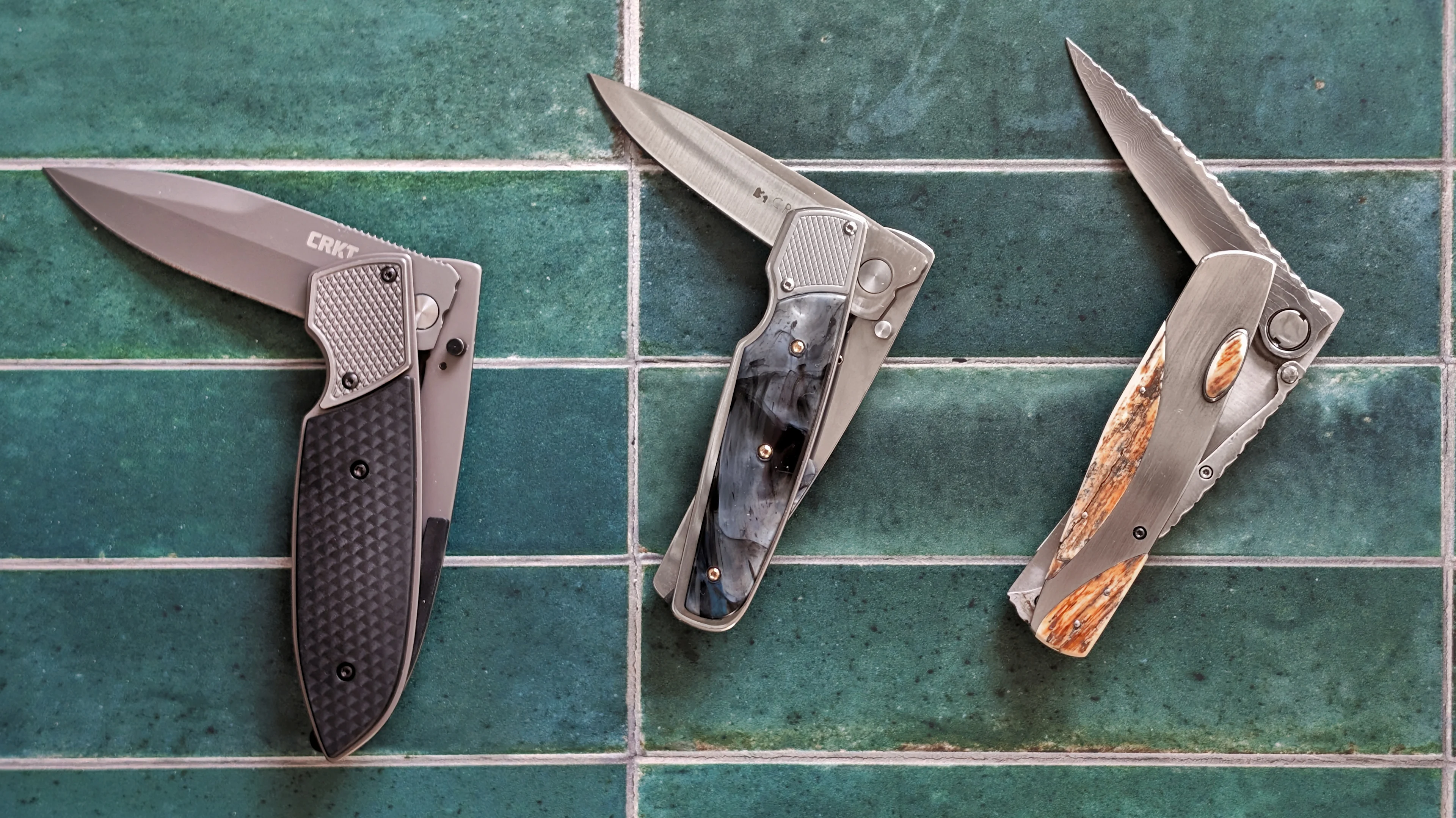
Fulcrum™2 circa 2016, Kommer Fulcrum™circa 2008, custom Charles Kain Fulcrum™ circa 2006
Originally released in 2008, the CRKT Kommer Fulcrum™ has been turning heads for nearly two decades, and not just for its sleek, refined lines. It’s an elegant gentleman’s knife with show-stopper looks, but the way it moves is what usually gets all the attention.
And now, a full decade after its initial release, and nearly two decades since the original, the updated Fulcrum™ 2 is back and ready to turn heads all over again
A Meeting of the Minds
Synergy. A whole greater than the sum of its parts. There’s many ways of describing that phenomenon when the work of two masters combine to make something truly incredible.
At CRKT, it is called “open source innovation,” where the ideas of separate knife and mechanism designers can meld together to form something totally new.
Few knife companies work this way, merging the outward designs of one maker with the inner mechanics of another, but this cross-pollination of ideas yields spectacular results. That’s how you get, say, a sleek knife designed by Lucas Burnley with a robust lock designed by Flavio Ikoma.
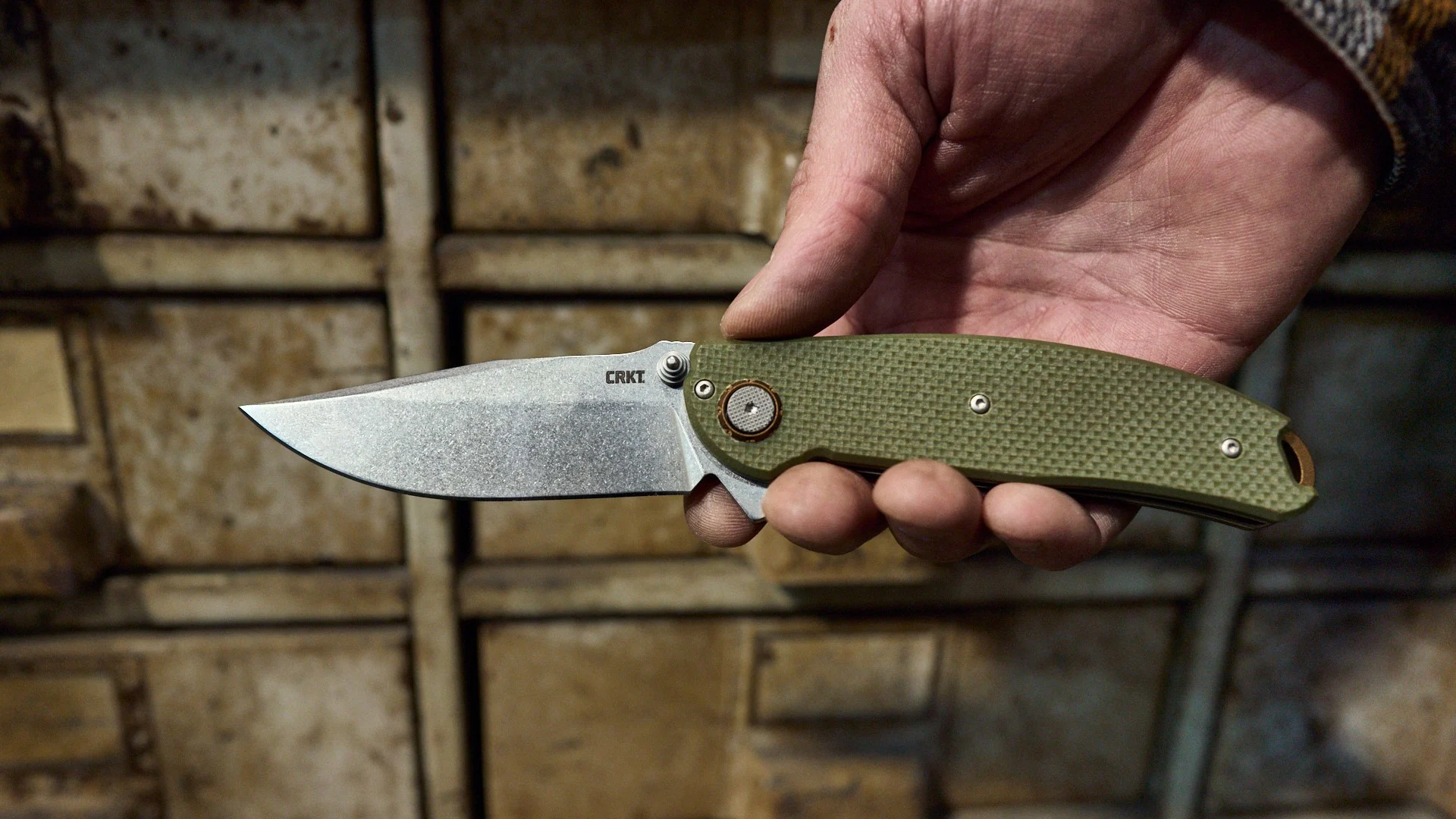
CRKT® Butte Deadbolt®, a merger of Lucas Burnley and Flavio Ikoma designs
And that’s exactly what the Kommer Fulcrum™ represents: the elegant curves and surefire ergonomics of seasoned knife maker Russ Kommer, with the mad-scientist mechanics of inventor Charles Kain.
But that kind of merger is no easy, drop-in task. Charles’ creative design requires very specific features and alignment not present on other knives. When CRKT founder Rod Bremer approached Russ with the idea of designing a folder around Charles’ invention, he knew it would be quite a challenge. He also knew that’s exactly the kind of challenge Russ loves. After a few months of tinkering, and more than one prototype hurled across a room in frustration, Russ finally came back with the Kommer Fulcrum™.
Opens Like No Other
Charles Kain is truly an outside-the-box thinker. Both an inventor and an artist, Charles crafts intricate, wild knives that intentionally entice and beguile the mind. Drawing inspiration from global mythology and folklore, his art knives often evoke demons and mythical monsters.
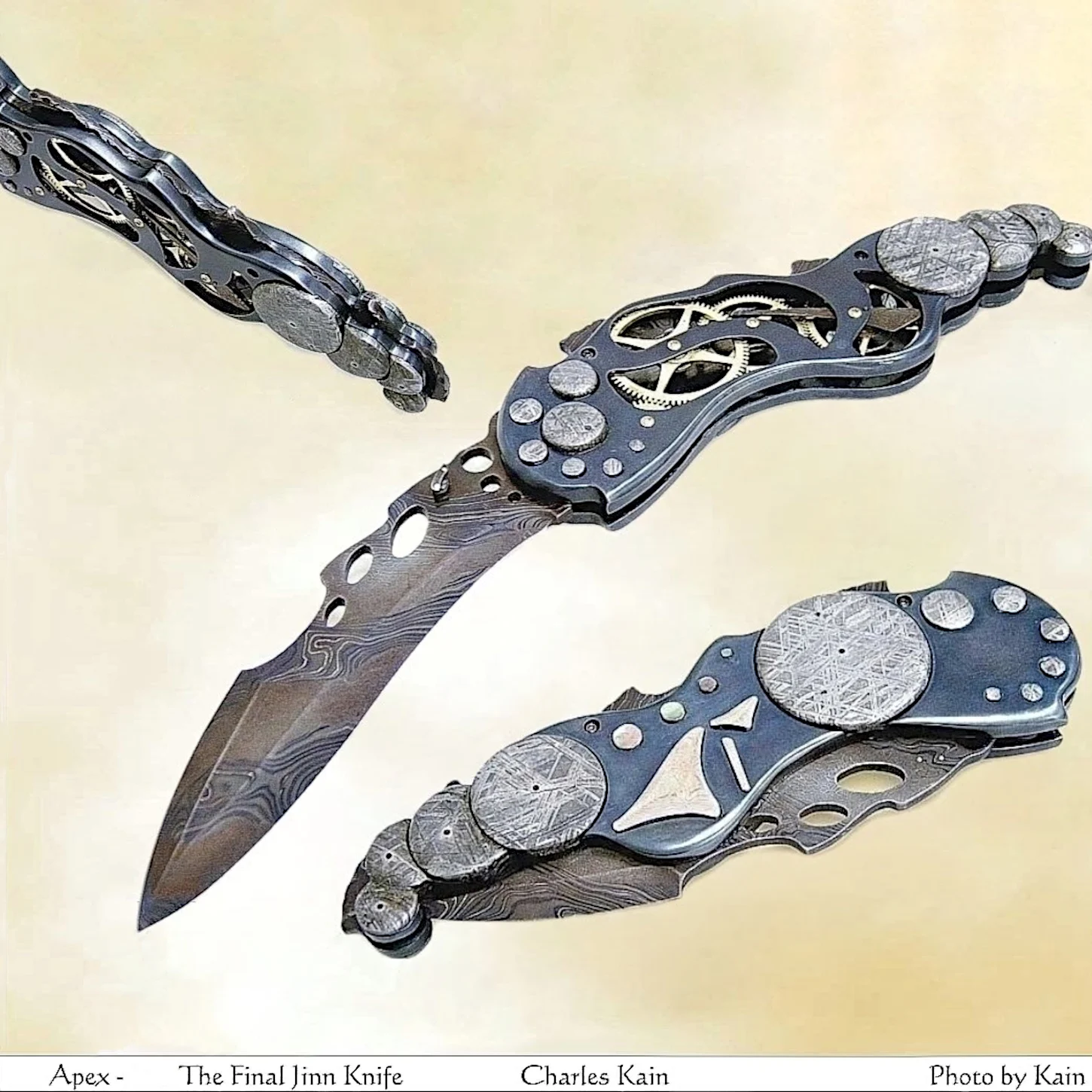
Apex automatic with functioning gears - Circa 2005 - Photo: Charles Kain (optimized for size)
It is that kind of wild imagination and creativity that led to Charles’ multiple patents and collaborations with CRKT, and his incredible Fulcrum™ opening mechanism.
To open the knife, you first push the two handle halves apart with your thumb, rotating them about a hidden rear pivot. This launches the blade into its initial, half-open position. Squeezing the handle halves back together finishes the job, propelling the blade into its fully open, locked position.
It might sound complicated, but with just a little practice, the two motions can be chained together into one fast, fluid action. At first it feels like sorcery, but the blade opens with such a satisfying, tactile sensation that you immediately know this is magic of the mechanical wizardry variety.
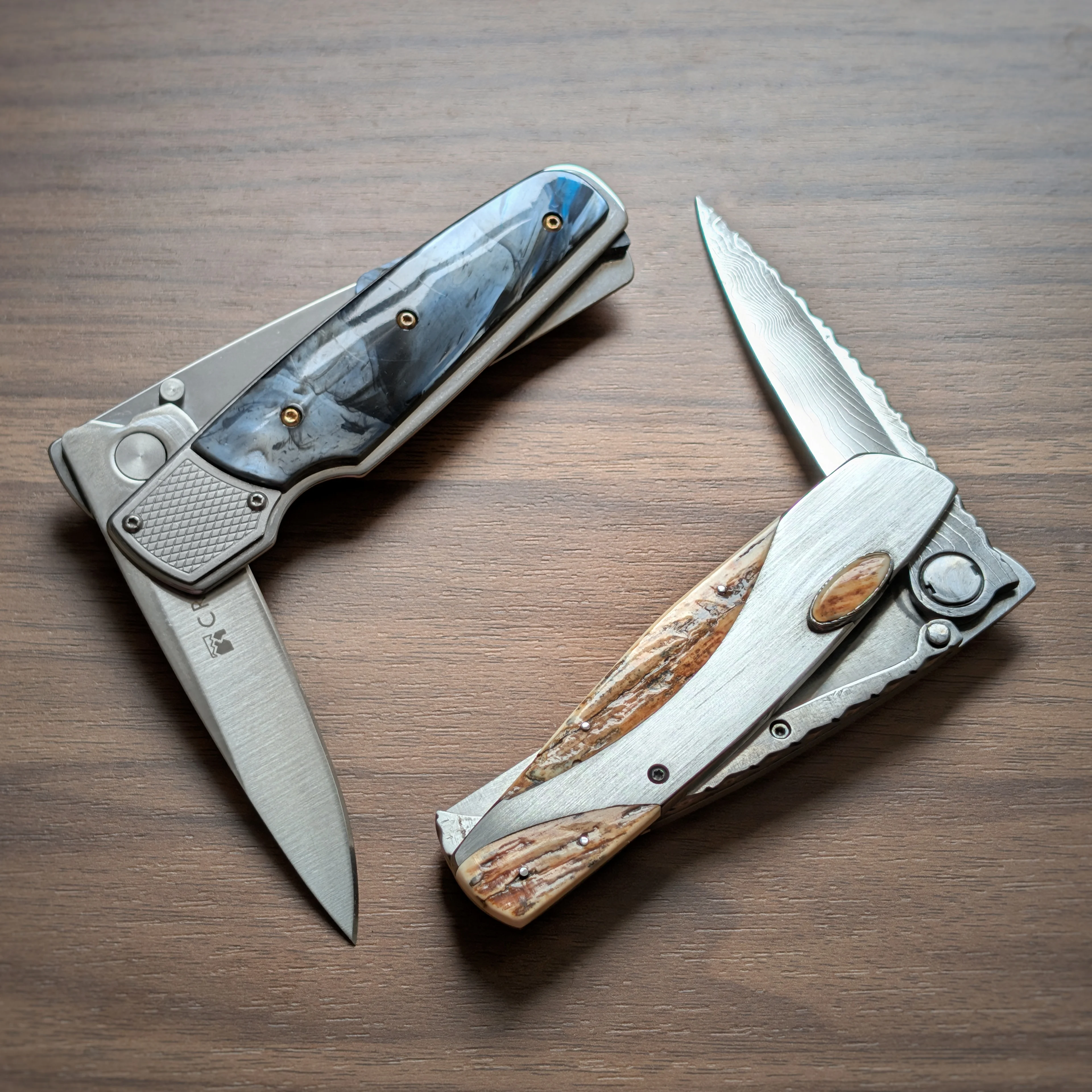
Kommer Fulcrum™ alongside custom Fulcrum™ with mammoth ivory and damascus blade
Brilliantly – and in fact, a bit perplexingly – closing the knife does not require this two-step process. Once you unlock the blade, it can be pushed closed in one continuous, fluid motion.
There has never been anything else like it on the market, literally ever. If you dig deep enough into knife mechanism history, there have been numerous obscure knives with split-handle designs, but none that use this splaying motion to propel the blade open. The CRKT Fulcrum™ truly opens like no other.
The Internal Magic
The secret to the Fulcrum's™ incredible movement lies hidden beneath its front bolster. A small, almost “V”-shaped slot has been machined into the handle scale. Resting inside that slot is a steel pin, attached directly to the blade tang
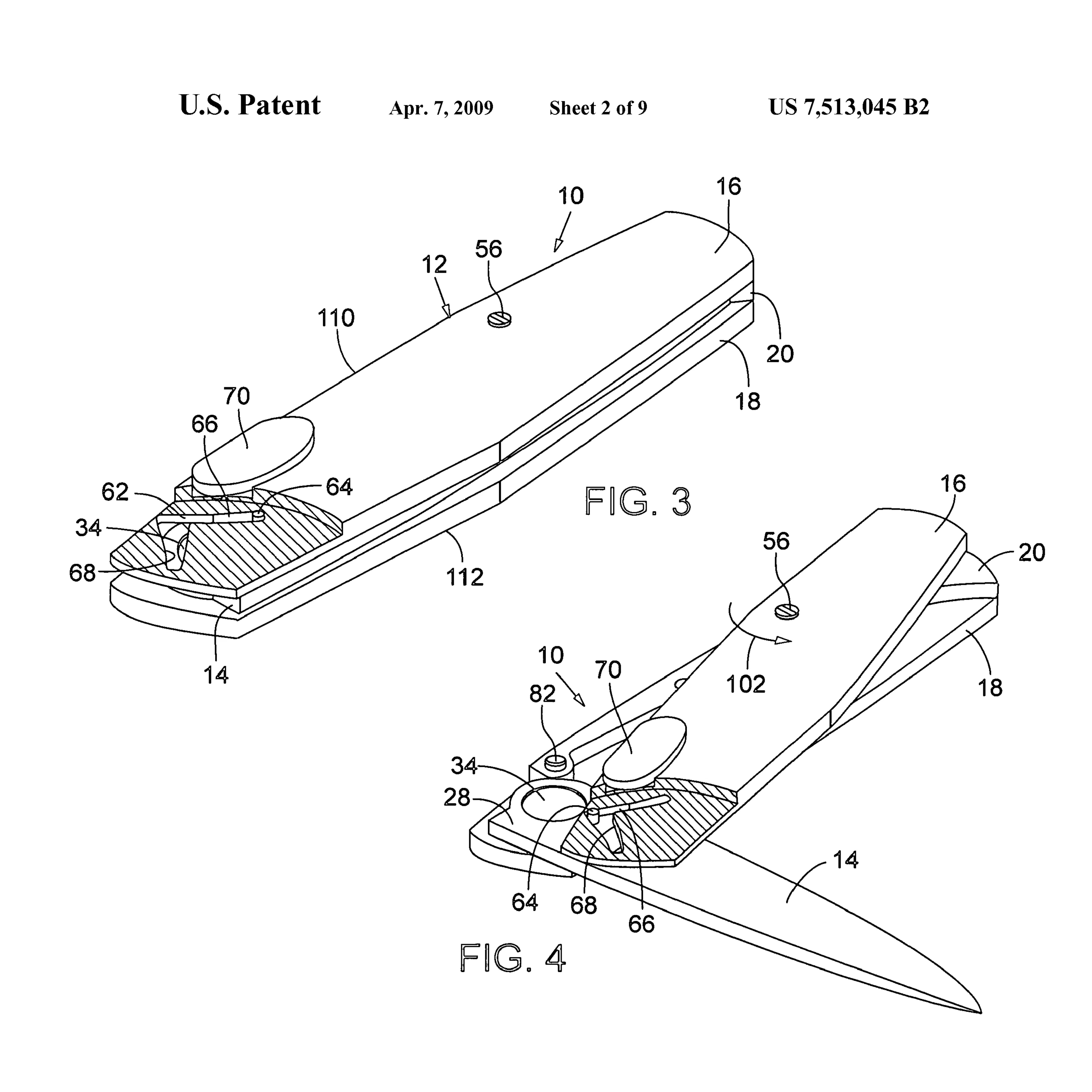
Patent diagram showing the guide path hidden underneath the bolster
Rotating the handle halves apart moves the guide slot outward, and in turn forces the inside pin to slide up its ramped surface. Since the pin is attached to the blade tang, the blade has no choice but to rotate open to facilitate this motion. The peculiar shape and proportions of this guide slot have been carefully engineered to link the handle and blade together, forcing them to move in unison. In mechanical engineering terms, the guide slot is called a “cam path,” with the pin acting as a “cam follower”.
Once the pin has reached the center of the “V,” the handle halves can no longer open any further, and the blade is stopped in the half-open position. But notice that it’s not a perfect “V”: one of its legs extends slightly further than the other, making the “center” of the “V” actually a bit off-center. This is crucial, as it is what transitions the pin onto the second stage of its journey.
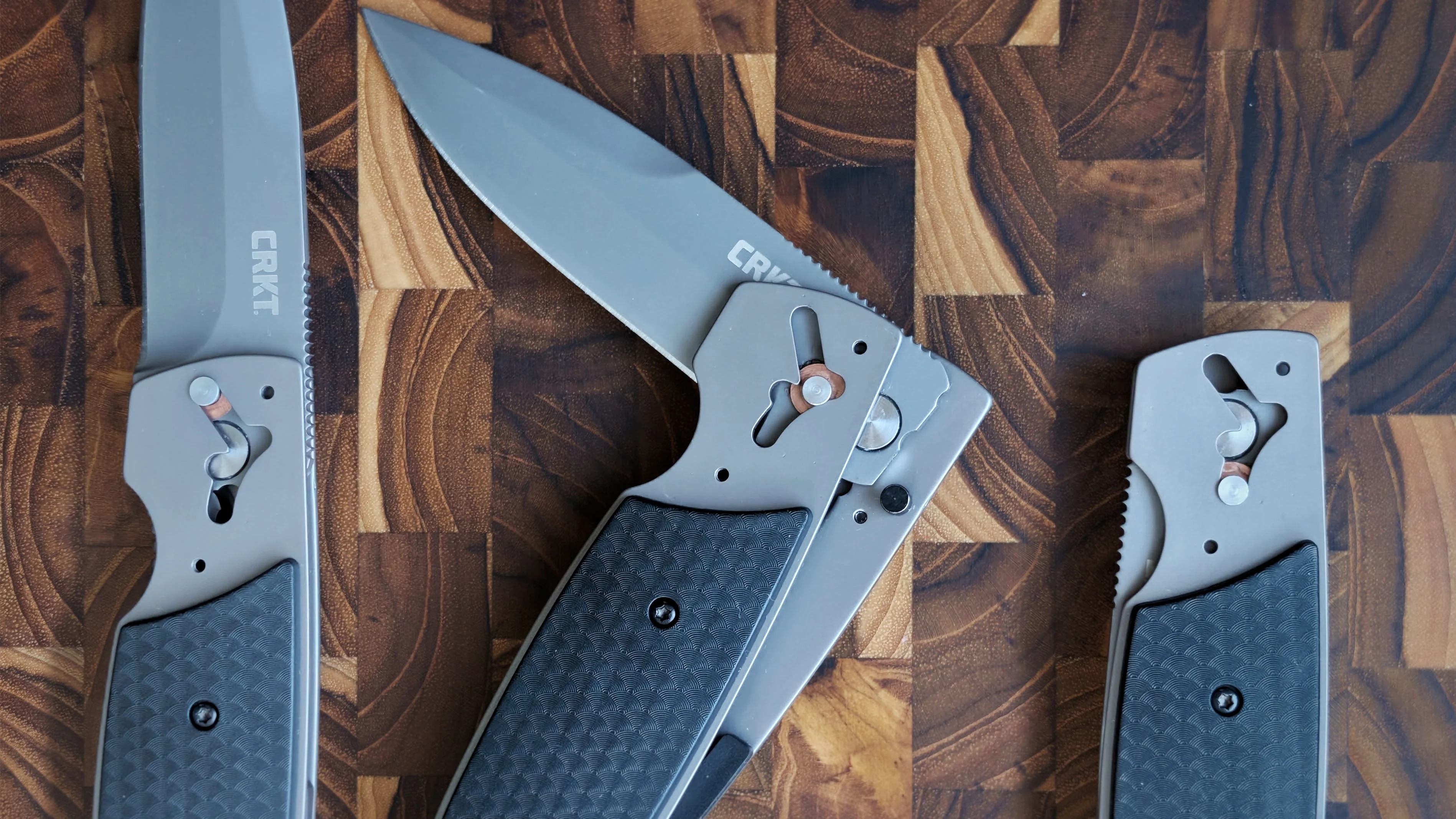
The pin in its open, mid-way, and closed positions
Once you begin to squeeze the handle paths together, rather than sliding back up the path it came, that off-center nature forces the pin to instead land in the second leg of the “V” and slide fully open.
That asymmetry of the guide slot is also what permits it to close in a single motion. When you push the blade closed, the pin is forced backward through the guide slot, and the handles are momentarily forced back apart. Because there isn’t a corresponding off-center notch in this direction, the pin seamlessly transitions from one leg of the guide slot to the other.
A Focus On Safety
Charles’ earliest rendition of the design had one notable flaw: under just the right conditions, squeezing the handle sides together had the potential to close the blade back down on your fingers. It was unlikely, but if the blade was opened to just the right spot, it was physically possible for the opening pin to slide back down the wrong leg of the guide slot, closing the blade rather than opening it. Remote possibility or not, this was obviously an unacceptable risk. Luckily, Charles had a clever solution.
By placing a small safety notch at the end of the first leg of the guide path, toward the center of the “V” shape, he could capture the pin and immediately stop it in its tracks. Taking it one step further, he added a carefully placed curvature to the guide path, directing the pin straight into the safety notch. Crisis averted.
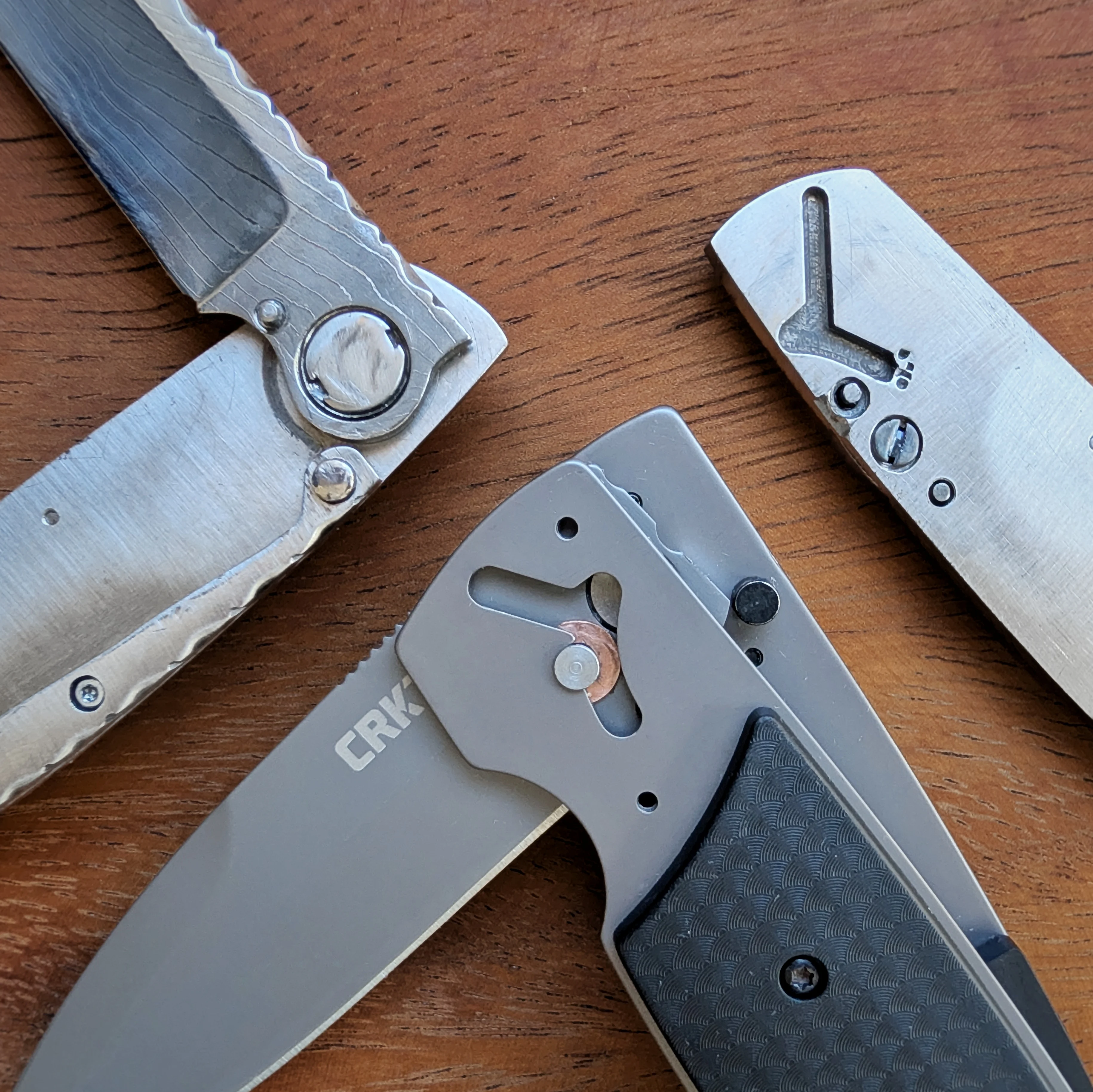
Updated path design with the opening pin captured in the safety catch
Lock Evolution
Charles initially envisioned his mechanism as a button lock, and indeed his Provisional Patent Application diagrams and hand-made custom prototypes all functioned this way. The blade was locked in both the open and closed positions, with the handle sides only capable of splaying apart once the user depressed the button.
While functional, this design had two major drawbacks: lock strength and blade play. Once open, closing pressure along the spine of the blade would attempt to push the pin back up the guide slot and splay the handle halves apart. While the button piston was capable of holding the two handle halves together under normal conditions, the force direction and leverage involved in this design was not ideal.
Additionally, in order to move smoothly through the guide slot, the pin needs to be slightly smaller than the slot itself. This extra space around the pin translates to wiggle room for the blade in the open position, resulting in veritcal play.
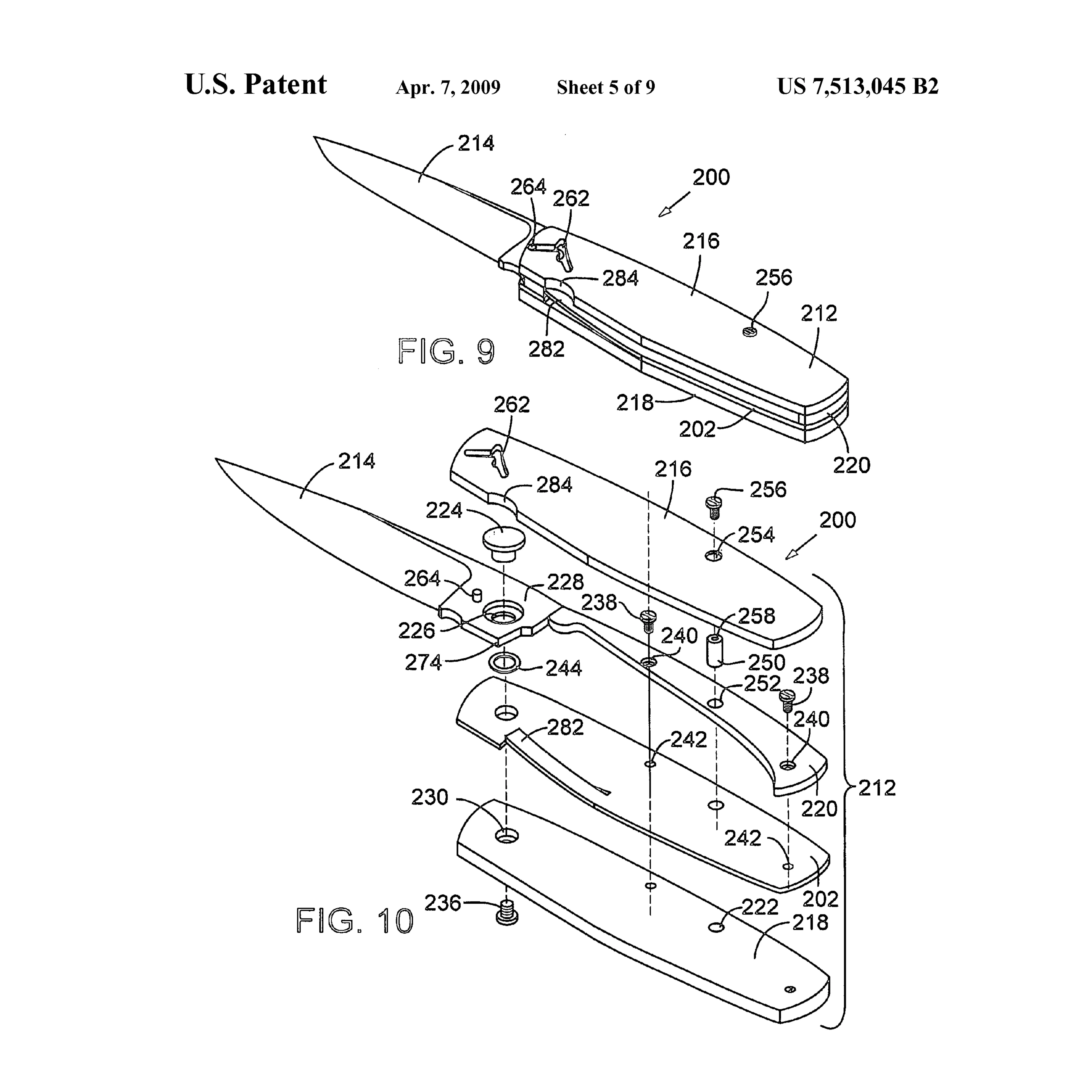
Updated design featuring Liner Lock and new safety catch
To remedy this situation, Charles incorporated a standard, secure Liner Lock into the design. Because the Fulcrum™ mechanism is contained entirely within the front scale of the handle, the rear scale could easily fit the necessary leaf-spring lock bar. In addition to its robust strength, the Liner Lock also provides firm, wiggle-free lockup.
This had the added benefit of allowing the knife to hold the blade closed with a standard detent ball. Not only does this provide a fun, snappy action, it also helps ensure that the blade fully reaches its mid-point position before the user attempts to squeeze the handle halves back together.
A Hunter's Gentleman's Knife
To call Russ Kommer an “experienced” outdoorsman would be a near comical understatement. By the time he designed the Kommer Fulcrum™ in 2008, Russ had already partnered with CRKT on numerous function-forward designs, drawing from his deep experience as a hunter and wildlife guide in rugged Idaho, Alaska, and North Dakota.

Russ’ knives have always had refined, graceful lines to them, but they had all been firmly rooted in their outdoor utility. They were purpose-built knives targeted at the kinds of rugged, demanding tasks found in the wild. The Kommer Fulcrum™ represented something new: a small, elegant gentleman’s knife.
The original 2008 version featured a compact 2.75” drop point blade in AUS-8 steel, with swirling, pearlescent CPL scales. It came in both blacked-out and satin versions, adding to its handsome, luxurious aesthetic.
By 2009, Russ managed to shrink things even further, and CRKT released the Kommer Mini Fulcrum™, matching the original in elegant aesthetics, but featuring a diminutive 2.19” blade. This was certainly not a hunting knife!
However, Russ cannot help but imbue his designs with practical ergonomics. Even at such a small size, the Kommer Fulcrum™ and its pint-sized little brother feel great in the hand, and are capable of some serious cutting. They might be refined in appearance, but they are still excellent, practical knives.
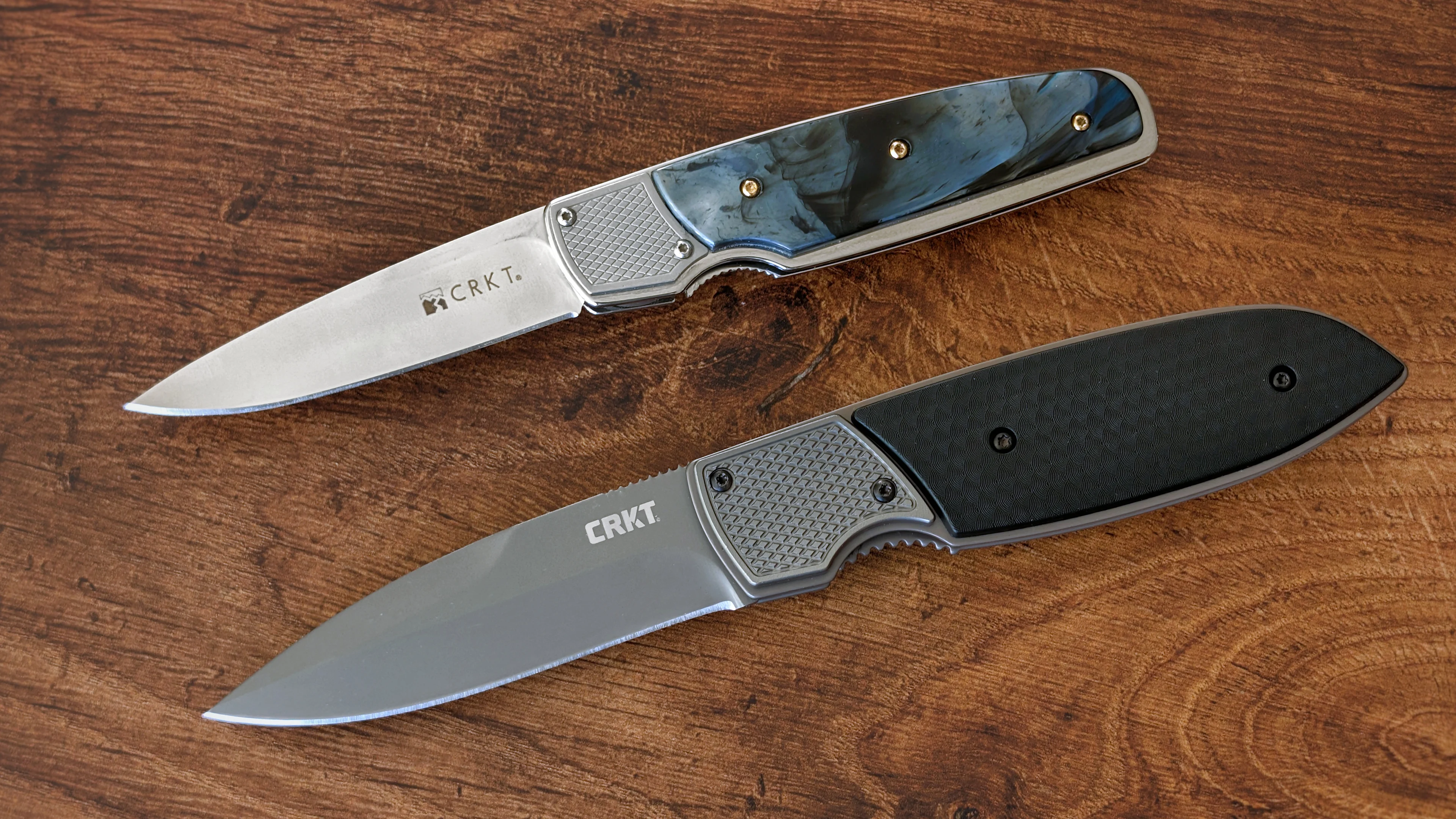
Kommer Fulcrum™ and Mini Fulcrum™, circa 2009
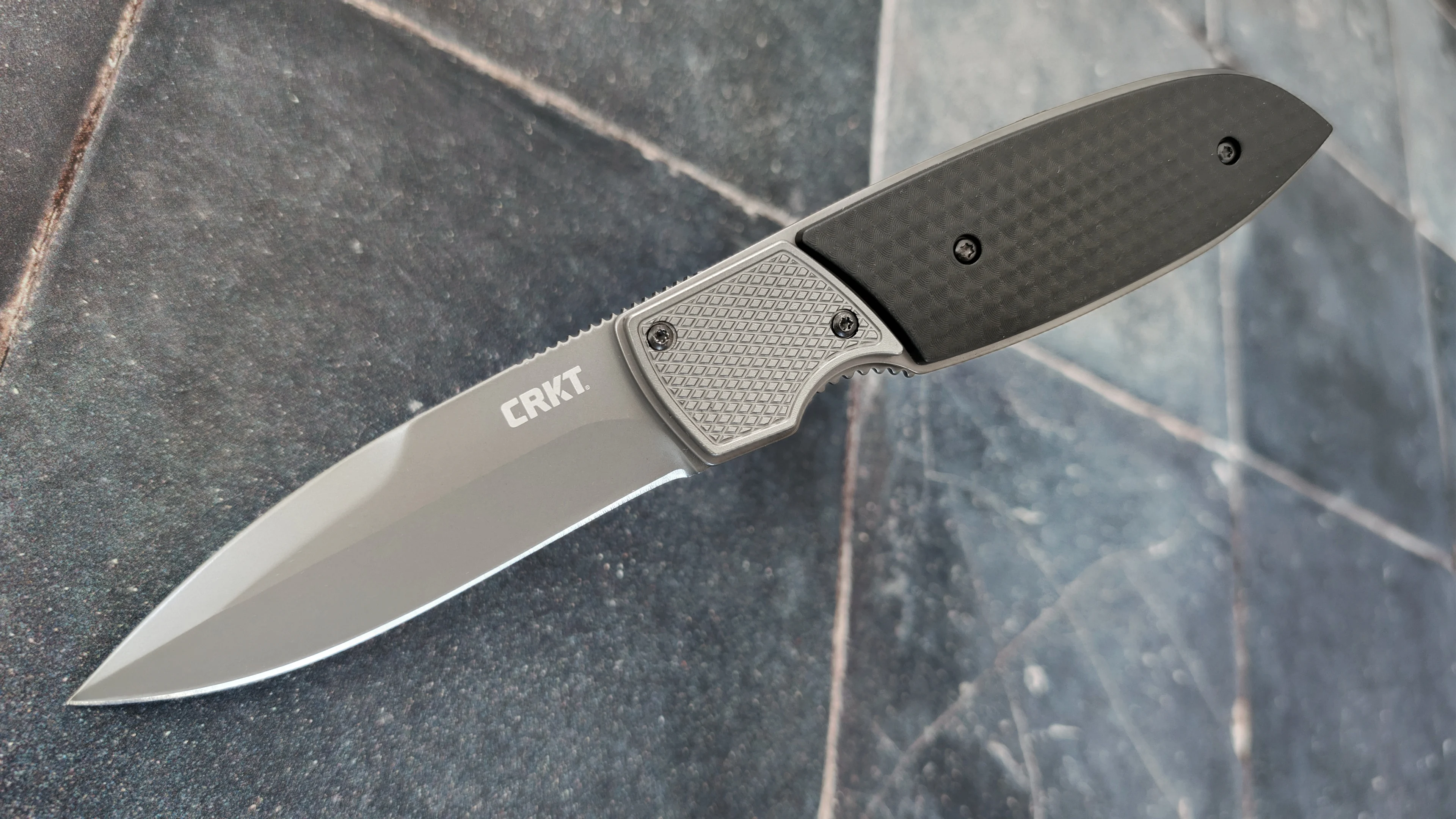
Nearly a decade later, CRKT released a new spin on the design: the Fulcrum™ 2. This version retained a similar graceful silhouette of the original, but expanded it to a more full-sized 3.18” high carbon stainless steel blade. Gone were the swirling CPL handles, replaced with a more rugged glass-reinforced nylon, textured with a mesmerizing pattern of cascading circles almost resembling rippling waves.
Additionally, Russ updated the bolsters on the Fulcrum™ 2, enlarging them and giving them a slight concave swoop, providing even better traction for your thumb when opening the knife. Russ rounded out the changes by dropping the tip of the blade a little lower, and adding a stylish swedge along the top.
A Knife Fit For James Bond
The CRKT Fulcrum™ 2 is a knife unlike anything else out there. Its sleek, elegant exterior conceals its true mechanical nature. This unexpected hybrid of refined looks and gadgety mechanics make the Fulcrum™ 2 feel like a knife straight out of a Bond film. And that’s exactly how you’ll feel when you open it, especially if any of your friends are around to witness it. Be prepared for some dropped jaws.
This special re-release perfectly recreates the magic of the original. This is your chance to own a truly unique piece of knife history.
Kevin Wells
Kevin Wells is the creator of Knife Nerdery, a YouTube channel driven by a simple question: how does that work? With an eye for engineering and design, he takes a close look at the mechanisms that make knives distinctive. Kevin also brings a deep knowledge of knife history to his videos, connecting today’s designs to the ideas and makers that came before them